


Headlines over the past week have said the FDA "approved" a list of peptides. That is not what happened, and the difference matters.
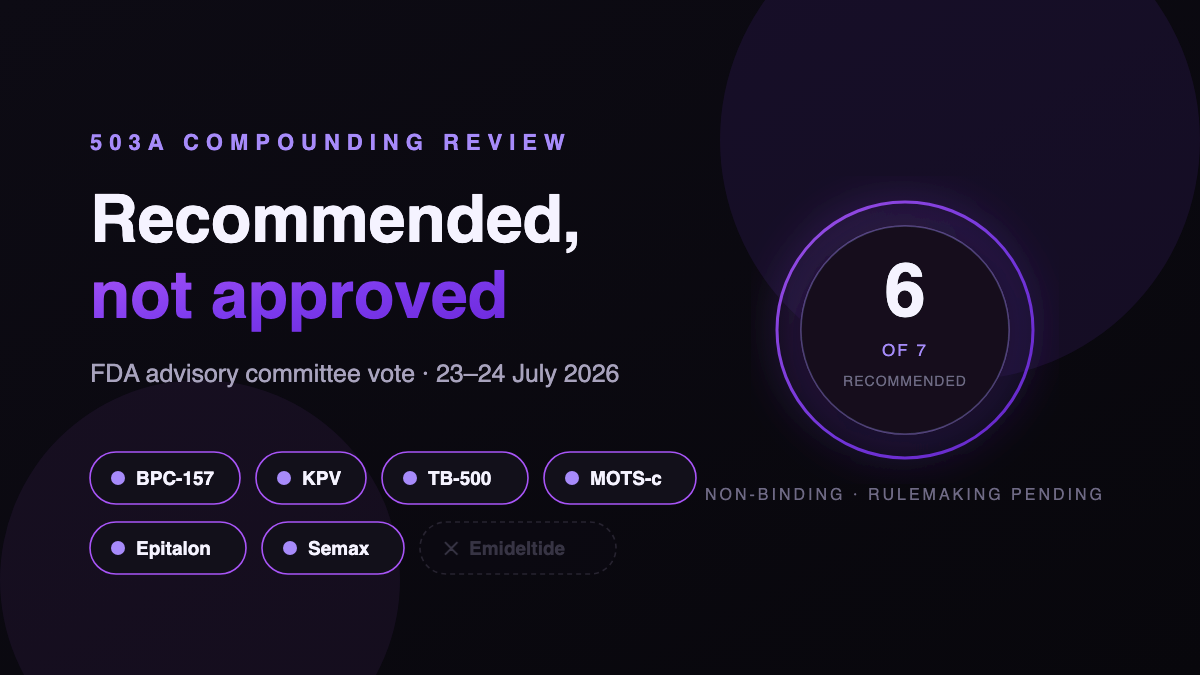
On 23–24 July 2026, the FDA's Pharmacy Compounding Advisory Committee (PCAC) voted on seven peptides for possible inclusion on the 503A Bulk Drug Substances List. Six were recommended. None were approved as drugs. No law has changed yet.
This article sets out what the committee actually decided, why the distinction between "compoundable" and "approved" is not a technicality, and what it means for anyone working with these compounds.
What the committee voted on
The 503A Bulks List governs which raw substances a state-licensed compounding pharmacy may use to prepare a preparation for an individual named patient. In 2023 the FDA placed a group of peptides into "Category 2" — substances with significant safety risks — which effectively removed them from legal compounding.
The July meeting revisited seven of them. The committee was asked a narrow question: should this substance be permitted for pharmacy compounding? It was not asked whether the substance is safe and effective for any condition. That question is answered by the drug approval process, which none of these peptides has been through.
The results
| Peptide | Committee outcome |
|---|---|
| BPC-157 | Recommended — 8 to 6, one abstention |
| KPV | Recommended |
| TB-500 | Recommended |
| MOTS-c | Recommended |
| Epitalon | Recommended |
| Semax | Recommended |
| Emideltide (DSIP) | Rejected — 6 to 7 |
Reported vote tallies varied between outlets for several of the substances, so only the two figures consistently reported across sources are given above. The direction of each vote is not in dispute.
Why "503A listed" is not "FDA approved"
| 503A Bulks List | FDA drug approval | |
|---|---|---|
| What it allows | A compounding pharmacy may prepare it for one named patient | A manufacturer may market it as a medicine |
| Efficacy evidence required | None | Adequate and well-controlled clinical trials |
| Manufacturing standard | Pharmacy compounding standards | Full pharmaceutical manufacturing controls |
| Status of these seven peptides | Under consideration | Unapproved drugs |
A peptide can sit on the 503A list and still have never been shown to work for anything. Inclusion is a statement about pharmacy practice, not about clinical evidence.
Three things that have not changed
1. The vote is not binding
PCAC advises; it does not decide. For any of these peptides to become legally compoundable, the FDA must act through formal public rulemaking — a process that commentators expect to run into 2027, and which the agency is not obliged to complete.
2. All seven remain unapproved drugs
Nothing about the vote changes their regulatory status today. None may be marketed, sold or supplied for human use.
3. FDA's own scientists objected
Agency staff opposed the additions, citing a lack of evidence to support effectiveness and noting that BPC-157 is not well characterised. Three adverse events were discussed, with causality unclear. Committee members who voted against pointed to the absence of randomised controlled trials; those in favour argued the decision belonged with physicians and pharmacists.
That split is the real story. This was not a finding that the peptides work. It was a disagreement about who should decide in the absence of evidence.
How the sector got here
- 2023 — FDA places a group of peptides in Category 2, ending legal compounding.
- February 2026 — HHS Secretary Robert F. Kennedy Jr. states publicly that most of the restricted peptides are expected to return to accessible status, prompting widespread coverage.
- April 2026 — FDA announces an advisory committee meeting to review seven of the substances.
- 23–24 July 2026 — PCAC recommends six, rejects one.
- Next — FDA decides whether to open rulemaking. Until then, nothing changes.
What this means if you work with research peptides
Practically: nothing yet. A favourable advisory vote does not make a compound a medicine, does not establish a dose, and does not make it lawful to administer to a person.
Everything PepSource supplies — including BPC-157, MOTS-c and Semax — is sold strictly as a research reagent for laboratory and in-vitro use by qualified researchers. That is unchanged by this vote and will remain unchanged if the FDA opens rulemaking. We make no therapeutic claims and provide no dosing or administration guidance.
What we do provide is verifiable identity and purity. Every batch we test has its certificate of analysis published, independently produced and checkable against the laboratory's own records. In a category where regulatory status is contested and shifting, provenance is the part a researcher can actually verify.
If you want to know what the published literature has genuinely investigated for these compounds — as opposed to what the internet asserts — our evidence reviews separate human clinical data from animal work and from unverified protocols: SS-31, MOTS-c and NAD+ and Semax.
Sources
- FDA — July 23–24, 2026 Meeting of the Pharmacy Compounding Advisory Committee
- RAPS — FDA advisory committee backs two controversial peptides
- STAT News — FDA advisory panel votes to allow compounding of unapproved peptides
- TIME — An FDA committee just voted in favour of peptides
- Pharmaceutical Executive — FDA panel votes to loosen restrictions
Research use only. All products referenced are supplied strictly as research reagents for laboratory and in-vitro use, and are not for human or veterinary consumption. This article reports regulatory developments and is not medical, legal or dosing advice.