Reconstitution is where a well-tested powder becomes a usable solution — and the choice of solvent affects both whether the peptide dissolves and how long the solution lasts. The two most common choices for research use are bacteriostatic water and dilute acetic acid.
Bacteriostatic water
This is sterile water containing a small amount of a bacteriostatic agent (commonly 0.9% benzyl alcohol) that suppresses microbial growth. Because of that agent, a reconstituted solution can be stored for longer than one made with plain sterile water. For the majority of readily soluble peptides, bacteriostatic water is the default. We stock it as bacteriostatic water in the lab supplies range.
Dilute acetic acid
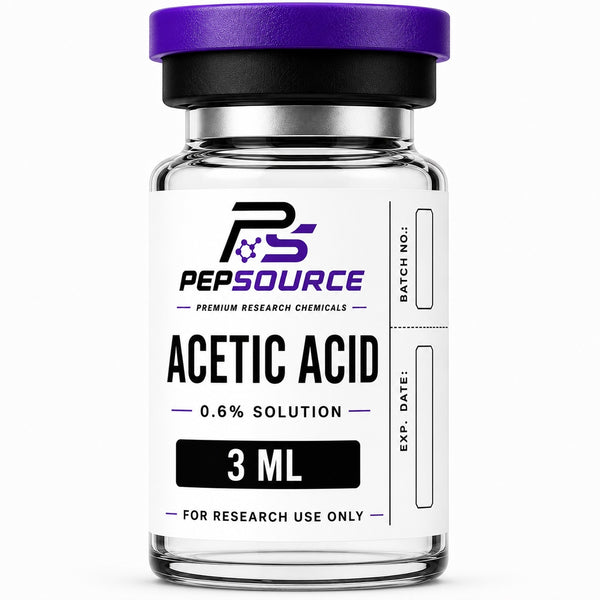
Some peptides are poorly soluble in near-neutral water and dissolve much better under mildly acidic conditions. A dilute acetic acid solution lowers the pH enough to bring these sequences into solution. It is a targeted tool rather than a default — reach for it when a peptide resists dissolving in bacteriostatic water. We stock 0.6% acetic acid for exactly this purpose.
How to choose
| Consideration | Bacteriostatic water | Dilute acetic acid |
|---|---|---|
| Best for | Readily soluble peptides | Poorly soluble / hydrophobic peptides |
| Storage life of solution | Longer (bacteriostatic agent) | Shorter; solvent-dependent |
| Default choice? | Yes, for most | Only when solubility requires it |
Getting the concentration right
Whichever solvent you use, your concentration calculation depends on knowing the actual mass of peptide in the vial — which is why the measured content on a certificate of analysis matters. If a vial labelled 10 mg measured 10.23 mg, use the measured figure. A reconstitution calculator then converts mass and solvent volume into concentration per unit.
After reconstitution
A dissolved peptide is less stable than the dry powder — keep it cold and follow the storage and handling guidance, avoiding repeated freeze-thaw. And remember all products are supplied strictly for laboratory research use only.