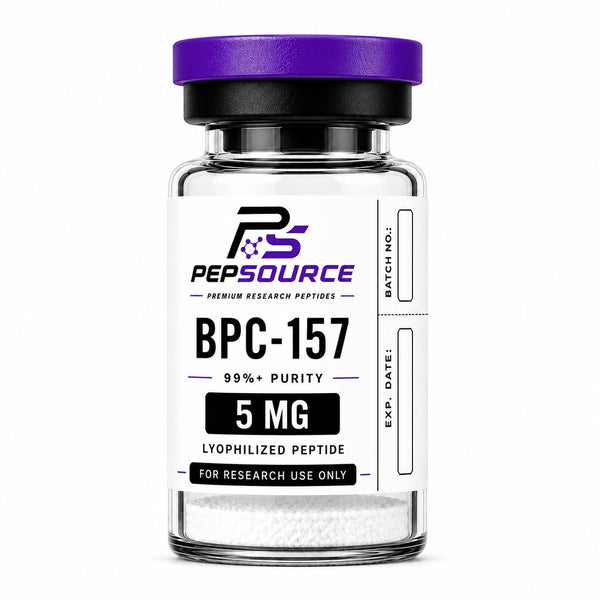
Most research peptides arrive as a fine white powder in a sealed vial. That form is not incidental — it is the result of lyophilisation (freeze-drying), and it is central to why a well-handled peptide stays intact.
What lyophilisation does
Lyophilisation removes water from a frozen solution by sublimation — ice passing directly to vapour under vacuum, without melting. The result is a dry, amorphous cake with very low residual moisture. Because most degradation pathways for peptides (hydrolysis, deamidation, oxidation) need water and mobility to proceed, removing water dramatically slows them down. A properly lyophilised peptide is far more stable than the same peptide in solution.
Why the cold chain still matters
Dry does not mean indestructible. Heat provides energy for degradation reactions and can cause the amorphous cake to collapse or take up moisture if the seal is compromised. Keeping vials cold from the moment of production — through storage, transit and delivery — preserves the advantage that freeze-drying creates. This is what “cold chain” means: an unbroken series of temperature-controlled steps.
From synthesis to your bench
- Synthesis and purification produce the raw peptide, which is then purity-tested and identity-confirmed.
- Lyophilisation converts the purified peptide to a stable powder.
- Cold storage holds the vials until dispatch.
- Protected shipping maintains temperature in transit.
Each step is only as good as the weakest link, which is why testing and handling are complementary, not alternatives.
What this means for you
When your vial arrives, keeping it cold and dry until use protects the material described on its certificate of analysis. Once reconstituted, the calculus changes entirely — see the guides on storage and laboratory handling and choosing a reconstitution solvent. You can browse cold-chain-handled compounds in the powder peptide catalogue — including BPC-157, Retatrutide and Glutathione — each lyophilised, sealed and dispatched with a published batch report. Compounds prepared to order are listed under made to order. All products are supplied strictly for laboratory research use only.